If you’re a business owner trying to boost your conversions and strengthen your digital presence, you’ve probably encountered these mysterious three-letter abbreviations: SEO, AIO, GEO, AEO, and SXO.
What do they mean? Which one should you focus on? And honestly, do you need to care about all of them?
Here’s the truth: understanding these optimization strategies isn’t just about keeping up with marketing jargon. It’s about meeting your customers where they actually are. Whether that’s on Google, ChatGPT, voice assistants, or AI-powered shopping experiences.
In this comprehensive guide, I’ll break down each optimization strategy with crystal clarity. You’ll understand their differences, discover their unique mental models, learn the metrics that matter, and get step-by-step implementation plans.
By the end, you’ll know exactly which strategy, or combination of strategies, will propel your business forward.
Let’s dive in!
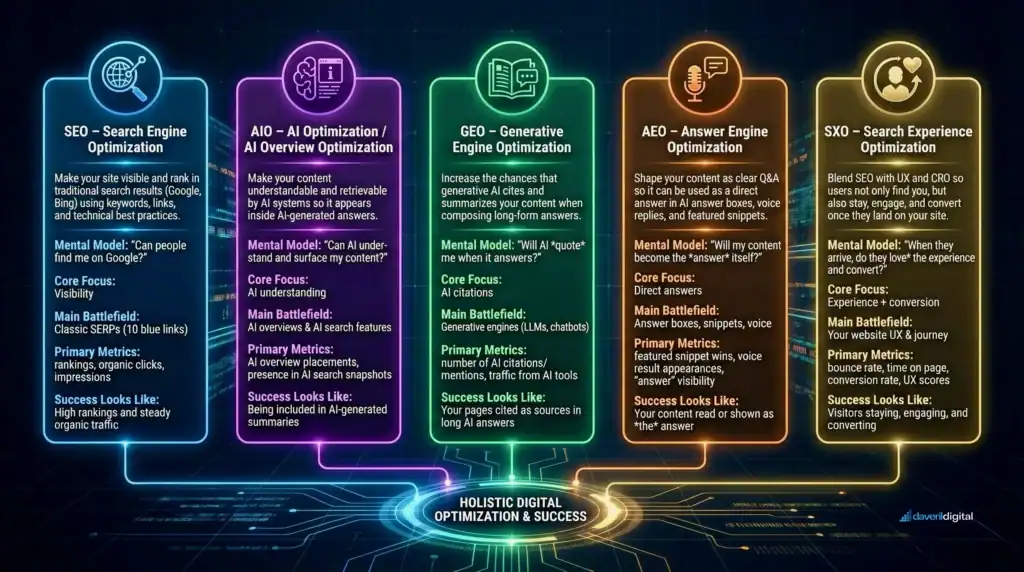
SEO, AIO, GEO, AEO, SXO Comparison and Main Differences
In a nutshell, here’s a quick comparison among SEO, AIO, GEO, AEO and SXO in terms of their use, target, content, success metrics, user intent, and timeframe.
Search Engine Optimization (SEO)
SEO has been the backbone of digital marketing for over two decades, and it’s not going anywhere soon. But what exactly is it, and how has it evolved in our AI-dominated world?
What is SEO?
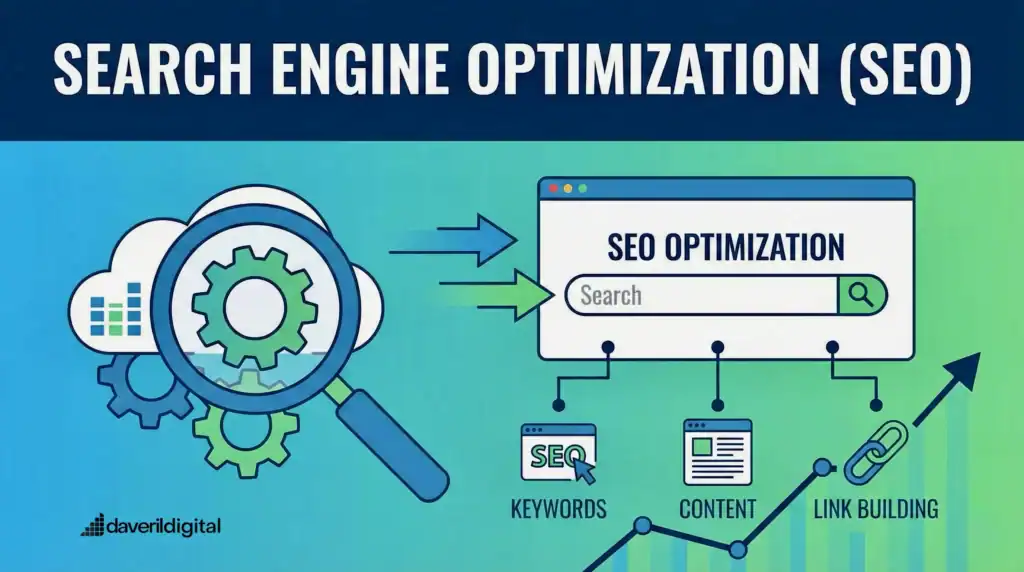
Search Engine Optimization (SEO) is the practice of optimizing your website and content to rank higher in traditional search engine results pages (SERPs), primarily Google, Bing, and Yahoo. It’s about making your content discoverable when people type queries into search boxes.
As digital marketing expert Chad Pollitt once said, “SEO is not something you do anymore. It’s what happens when you do everything else right.”
The goal? To appear on that coveted first page (ideally in the top three positions) for keywords relevant to your business. Why? Because 75% of users never scroll past the first page of search results.
SEO Core Focus & Mental Model
Think of SEO as optimizing for librarians (yup, the search engines). Search engines are like incredibly sophisticated librarians who need to understand what your “book” (website) is about, determine its quality, and decide which shelf (ranking position) it deserves.
Primary Focus:
- Keyword relevance and intent
- Technical website health
- Content quality and depth
- Backlink authority (other websites linking to yours)
- User engagement signals
The SEO Mindset asks
“How can I make my website the most relevant, authoritative, and user-friendly answer to what people are searching for?”
SEO Key Metrics
To measure SEO success, here are some of the critical metrics that you need to track:
- Organic traffic – Visitors coming from search engines
- Keyword rankings – Where you appear for target search terms
- Click-through rate (CTR) – Percentage of people who click your result
- Domain Authority (DA) – Overall site credibility score
- Backlinks – Number and quality of sites linking to you
- Page load speed – How fast your pages load
- Bounce rate – Percentage of visitors who leave immediately
- Conversion rate – Visitors who complete desired actions
SEO Success Factors
What separates SEO winners from losers? These factors:
- High-quality, original content that genuinely helps users
- Technical excellence (fast loading, mobile-friendly, secure)
- Strategic keyword targeting based on search intent
- Strong backlink profile from reputable sources
- Consistent content publishing schedule
- User experience optimization (easy navigation, clear CTAs)
- Local SEO optimization (for location-based businesses)
Step-by-Step SEO Implementation
Ready to implement SEO? Follow this roadmap:
Step 1: Conduct keyword research
Use tools like Google Keyword Planner, Ahrefs, or SEMrush to identify keywords your target audience searches for. Focus on a mix of high-volume keywords and long-tail phrases with lower competition.
Step 2: Audit your Technical SEO
Ensure your website is crawlable, has a logical structure, loads quickly, and is mobile-responsive. Fix broken links, create an XML sitemap, and implement schema markup.
Step 3: Create cornerstone content
Develop comprehensive, authoritative content around your main topics. These pillar pages should be extensive (2,500+ words) and cover topics thoroughly.
Step 4: Optimize On-Page elements
Write compelling title tags, meta descriptions, header tags, and image alt text. Ensure your content naturally incorporates target keywords.
Step 5: Build quality backlinks
Create link-worthy content, reach out for guest posting opportunities, and build relationships with industry influencers. Quality over quantity always wins.
Step 6: Monitor and adjust
Use Google Analytics and Search Console to track performance. Analyze what’s working, identify opportunities, and continuously refine your strategy.
AI Optimization (AIO)
Welcome to the newest frontier in digital optimization. AIO is where traditional SEO meets the AI revolution, and it’s reshaping how we think about visibility online.
What is AIO?
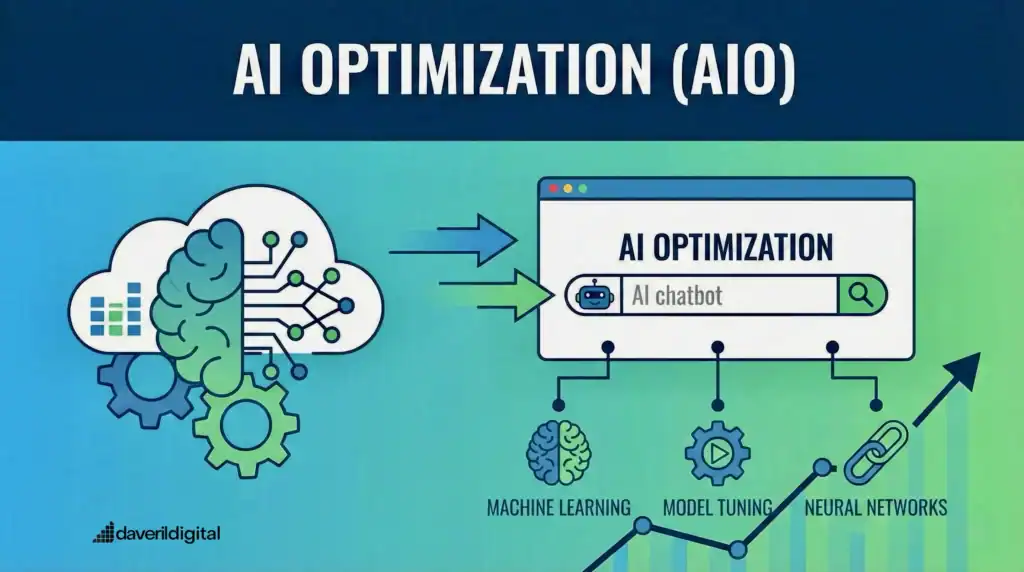
AI Optimization (AIO) is the practice of optimizing your content and digital presence to appear in AI-generated responses from platforms like ChatGPT, Claude, Google’s AI Overviews, Bing Chat, and other large language models (LLMs).
Unlike traditional search engines that show a list of links, AI platforms synthesize information and provide direct answers. AIO ensures your content becomes part of that synthesis.
AIO Core Focus & Mental Model
Think of AIO as becoming the expert source. AI models don’t just index your content. They learn from it, reference it, and potentially cite it when answering user questions.
Primary Focus:
- Authoritative, factual content
- Structured, citation-worthy information
- Brand mentions and recognition
- Expertise, Experience, Authoritativeness, Trustworthiness (E-E-A-T)
- Natural language and conversational content
- Clear attribution and sourcing
The AIO Mindset asks
How can I position my content as the go-to source that AI models trust and reference?”
AIO Key Metrics
Measuring AIO is trickier than traditional SEO, but these metrics matter:
- AI Visibility Score – How often you’re cited in AI responses
- Brand Mentions – Frequency of your brand appearing in AI outputs
- Citation Rate – When AI tools link to or reference your content
- Conversational Traffic – Visitors coming from AI platforms
- Source Authority – Recognition as a primary information source
- Content Comprehensiveness – Depth and breadth of topic coverage
AIO Success Factors
To win at AIO, you need:
- Exceptional content quality that establishes clear expertise
- Structured data implementation (schema markup, JSON-LD)
- Comprehensive topic coverage (not just surface-level content)
- Clear authorship credentials (author bios, credentials, expertise)
- Original research and data (studies, surveys, unique insights)
- Natural language optimization (conversational, question-answering format)
- Regular content updates (keeping information current)
Step-by-Step AIO Implementation
Here’s how to optimize for AI:
Step 1: Identify key topics and questions
Research the questions your audience asks AI tools. Use platforms like AnswerThePublic, examine “People Also Ask” sections, and survey your customers.
Step 2: Create comprehensive, authoritative content
Write in-depth articles that thoroughly answer questions. Include statistics, expert quotes, case studies, and original insights. Aim for 2,500+ words for pillar content.
Step 3: Implement Structured Data
Add schema markup to help AI understand your content’s context. Use Article, FAQPage, HowTo, and other relevant schema types.
Step 4: Establish author credibility
Create detailed author pages showcasing expertise, credentials, and experience. Link to professional profiles and published work.
Step 5: Optimize for natural language
Write conversationally and use questions as headers. Structure content the way people actually speak and ask questions.
Step 6: Monitor AI platforms
Regularly search for your brand and topics in ChatGPT, Claude, Perplexity, and Google AI Overviews. Track when and how you’re mentioned.
Generative Engine Optimization (GEO)
If AIO is broad, GEO is laser-focused. This emerging discipline specifically targets generative AI search experiences like ChatGPT, Perplexity AI, and similar platforms.
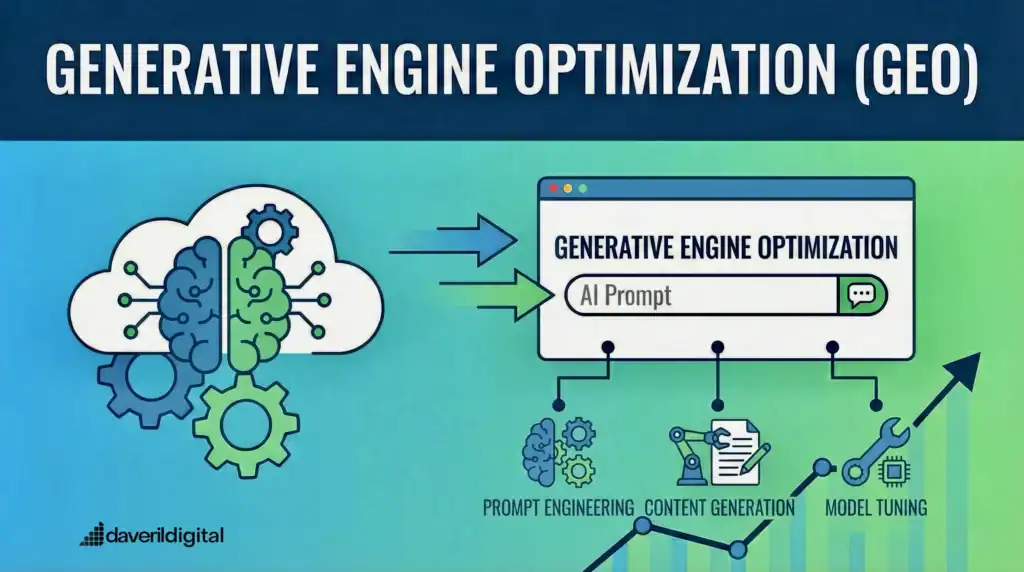
What is GEO?
Generative Engine Optimization (GEO) is the specialized practice of optimizing content to appear prominently in responses generated by AI search engines and conversational AI platforms. It’s essentially SEO’s younger, tech-savvy sibling.
The key difference? Traditional search engines show you where to find answers. Generative engines are the answer. They synthesize information from multiple sources and present it conversationally.
GEO Core Focus & Mental Model
Think of GEO as training the AI trainer. You’re not just optimizing for algorithms; you’re optimizing for AI models that learn, reason, and generate unique responses.
Primary Focus:
- Source credibility and reliability
- Content depth and context
- Semantic relationships and topic clusters
- Natural language processing optimization
- Real-time information freshness
- Multi-perspective coverage
The GEO Mindset asks
“How can I make my content so valuable and trustworthy that generative AI prioritizes it when answering user queries?”
GEO Key Metrics
GEO success is measured through:
- Generative visibility – appearance rate in AI-generated responses
- Source attribution – direct citations and references
- Context relevance – how appropriately your content is used
- Query coverage – number of different queries triggering your content
- Competitive displacement – appearing instead of competitors
- Semantic authority – recognition as a topic authority
GEO Success Factors
Winning at GEO requires:
- Primary source content (original research, first-hand experiences)
- Multi-format content (text, data, images, structured info)
- Topic cluster architecture (interconnected, comprehensive coverage)
- Semantic SEO optimization (related concepts, entity relationships)
- Frequent content updates (especially for time-sensitive topics)
- Clear, scannable formatting (headers, lists, tables)
- Expert-level depth (going beyond surface explanations)
Step-by-Step GEO Implementation
Let’s implement GEO effectively:
Step 1: Build Topical Authority clusters
Create hub-and-spoke content structures. Your hub is a comprehensive pillar page, with spokes being detailed subtopic articles that link back to the hub.
Step 2: Prioritize primary sources
Conduct original research, surveys, or experiments. Publish unique data that doesn’t exist elsewhere. Generative AI prioritizes primary sources.
Step 3: Optimize for semantic search
Use tools like MarketMuse or Clearscope to identify semantically related terms. Cover topics comprehensively, including related concepts and entities.
Step 4: Structure for AI consumption
Use clear hierarchies, descriptive headers, and structured formats. Think: “If an AI had to quickly extract key information, would my formatting make that easy?”
Step 5: Establish content freshness
Regularly update your content with new information, statistics, and insights. Mark update dates clearly. Freshness signals credibility.
Step 6: Create comparative and analytical content
Generative AI loves content that compares options, analyzes situations, and provides multi-perspective views. Create comparison guides, pros/cons analyses, and scenario breakdowns.
Answer Engine Optimization (AEO)
Before generative AI exploded, there was AEO. This strategy focuses on voice assistants and featured snippets and it’s still incredibly relevant.
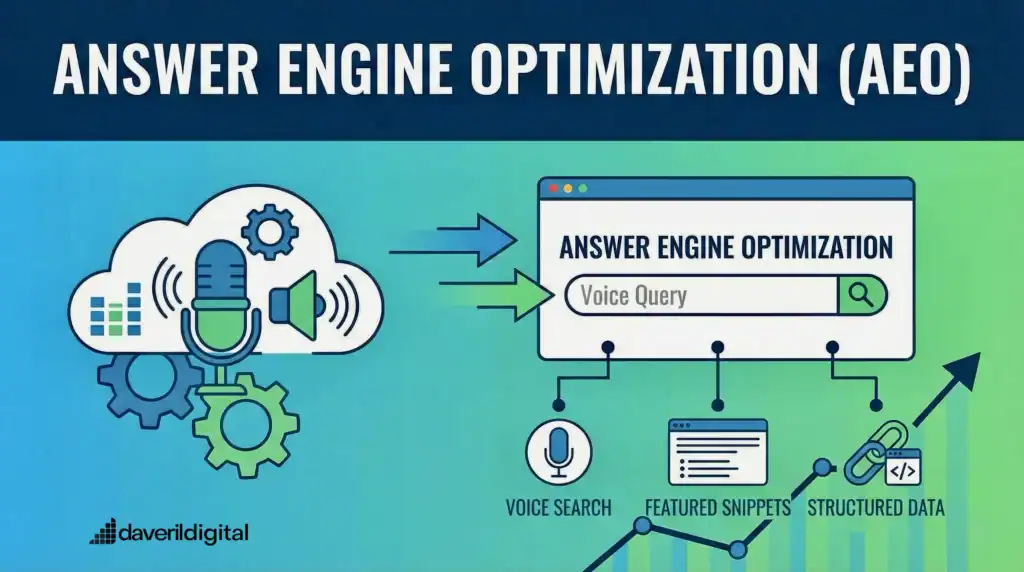
What is AEO?
Answer Engine Optimization (AEO) is the practice of optimizing content to provide direct, concise answers that appear in featured snippets, voice search results, and AI assistants like Siri, Alexa, and Google Assistant.
AEO emerged from a simple observation: people weren’t just searching anymore, they were asking. And they expected immediate, spoken answers, not a list of links.
As Exposure Ninja puts it, “Zero-click searches are the new normal.” If you’re not optimizing for answers, you’re invisible.
AEO Core Focus & Mental Model
Think of AEO as being the perfect Jeopardy! contestant. You need to provide a clear, exact and concise answer to the question.
Primary Focus:
- Question-based content structure
- Concise, direct answers
- Featured snippet optimization
- Voice search compatibility
- Structured FAQ content
- Natural language queries
The AEO Mindset asks
“If someone asked this question out loud, would my content provide the perfect, citation-worthy answer?”
AEO Key Metrics
Track these AEO-specific metrics:
- Featured snippet ownership – Number of snippets you own
- Voice search traffic – Visitors from voice-activated devices
- Position zero rankings – Queries where you appear above #1
- Answer box appearances – Frequency in Google’s answer boxes
- Question-based rankings – Performance for question queries
- Zero-click retention – Brand recall from answer-only results
AEO Success Factors
AEO success depends on:
- Question-focused content (targeting “who,” “what,” “when,” “where,” “why,” “how”)
- Concise answer paragraphs (40-60 words ideal for snippets)
- FAQ sections (structured Q&A format)
- List and table formatting (easy for algorithms to extract)
- Long-tail keyword targeting (specific, conversational phrases)
- Schema markup implementation (especially FAQPage schema)
- Mobile optimization (most voice searches are mobile)
Step-by-Step AEO Implementation
Here’s your AEO action plan:
Step 1: Research question keywords
Use tools like AnswerThePublic, AlsoAsked, and Google’s “People Also Ask” to identify question-based queries in your niche.
Step 2: Structure content around questions
Use questions as H2 or H3 headers. Immediately follow with a concise, direct answer in the first paragraph (40-60 words).
Step 3: Create dedicated FAQ pages
Build comprehensive FAQ sections for each major topic. Use FAQPage schema markup to maximize visibility.
Step 4: Optimize for voice search
Write conversationally. Target long-tail, natural language phrases people actually speak. Think: “what’s the best coffee maker under $100” not “coffee maker budget.”
Step 5: Format for snippet extraction
Use numbered lists, bullet points, and tables where appropriate. Make information easy to extract and display.
Step 6: Target Featured Snippet opportunities
Identify keywords where competitors own snippets. Create superior content that answers the query more effectively.
Search Experience Optimization (SXO)
SXO represents the marriage of SEO and UX (user experience). It’s not enough to rank high. You need to convert users as customers by delivering an exceptional experience once they arrive.
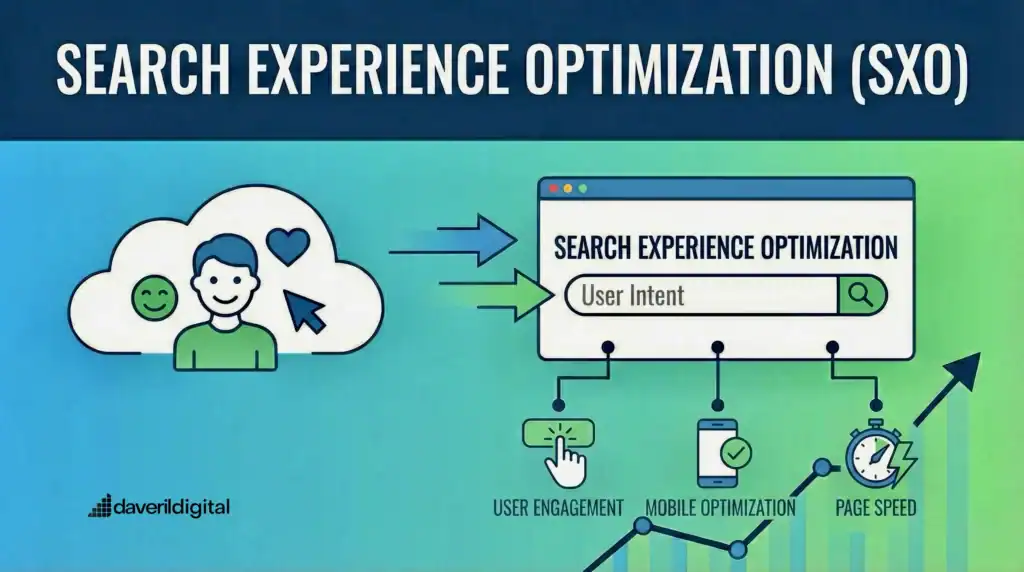
What is SXO?
Search Experience Optimization (SXO) is the holistic approach of combining SEO principles with user experience design to not just attract visitors, but to guide them seamlessly toward conversion.
SXO acknowledges a critical truth: ranking #1 means nothing if visitors immediately bounce because your site is confusing, slow, or frustrating to use.
SXO Core Focus & Mental Model
Think of SXO as hosting the perfect party. SEO gets people to show up (visibility), but SXO ensures they have an amazing time and want to stay (engagement and conversion).
Primary Focus:
- User journey optimization
- Page speed and performance
- Mobile experience excellence
- Clear conversion pathways
- Content readability and engagement
- Trust signals and credibility
- Personalization and relevance
The SXO Mindset asks
“Am I not only visible but also providing such a great experience that visitors naturally convert?”
SXO Key Metrics
SXO success is measured through:
- Conversion rate – Percentage completing desired actions
- Time on site – Average session duration
- Pages per session – Engagement depth
- Bounce rate – Percentage leaving immediately
- Core Web Vitals (CWV) – Google’s UX performance metrics (LCP, FID, CLS)
- Customer Satisfaction (CSAT) – Direct user feedback
- Return visitor rate – Users coming back
SXO Success Factors
SXO winners focus on:
- Lightning-fast page speeds (under 3 seconds)
- Mobile-first design (responsive, thumb-friendly)
- Intuitive navigation (clear menu structure, breadcrumbs)
- Compelling CTAs (clear, action-oriented buttons)
- Visual hierarchy (guiding eyes to important elements)
- Trust signals (reviews, testimonials, security badges)
- Personalized experiences (dynamic content, recommendations)
- Accessibility (WCAG compliance, inclusive design)
Step-by-Step SXO Implementation
Transform your search experience with these steps:
Step 1: Audit your user journey
Map out typical user paths from search to conversion. Identify friction points, confusing elements, and abandonment triggers.
Step 2: Optimize Core Web Vitals
Use Google PageSpeed Insights to assess performance. Improve Largest Contentful Paint (LCP), First Input Delay (FID), and Cumulative Layout Shift (CLS).
Step 3: Enhance mobile experience
Test your site on multiple devices. Ensure buttons are thumb-sized, text is readable without zooming, and forms are mobile-friendly.
Step 4: Simplify navigation
Reduce menu complexity and use descriptive labels. Implement search functionality. Add breadcrumbs for context.
Step 5: Optimize conversion pathways
Place clear CTAs above the fold. Remove unnecessary steps and reduce form fields to just 1-2. Make checkout frictionless.
Step 6: Implement trust elements
Add customer reviews, security badges, guarantees, and social proof throughout your site. Build credibility at every touchpoint.
Step 7: Personalize the experience
Use behavior-based recommendations, location-specific content, and returning visitor recognition to create tailored experiences.

Need help with SEO, AIO, GEO, AEO or SXO?
We’ve helped e-comnmerce, real estate, hospitality and professional services firms rank from page 4 to #1 spot in Google SERPs for competitive keywords.
We’re confident we can do the same for you.
Contact us now
Which Strategy Should You Choose?
Here’s the million-dollar question: which optimization strategy deserves your time, energy, and budget? The answer isn’t as simple as picking one but I’ll help you figure it out.
Factors to Consider for Your Business
1. Where your audience actually Is
Start with data, not assumptions. Where do your customers currently find information?
- If they’re Googling solutions → SEO is essential
- If they’re asking ChatGPT for advice → AIO and GEO matter
- If they’re using voice assistants → AEO is crucial
- If they’re abandoning your site quickly → SXO needs attention
Use analytics, customer surveys, and direct conversations to understand their behavior.
2. Your industry and competition level
Some industries are AI-forward (tech, SaaS, finance), while others remain search-traditional (local services, certain B2B niches).
- High competition industries: Need multi-channel optimization (SEO + SXO minimum)
- Emerging markets: Can benefit from early GEO adoption
- Local businesses: Should prioritize AEO for voice search and local queries
- E-commerce: SXO is non-negotiable for conversion optimization
3. Your resources and capacity
Be realistic about what you can execute well:
- Limited time/budget: Focus on SEO + SXO (foundation first)
- Medium resources: Add AEO for quick wins
- Strong team: Implement SEO, SXO, AEO, and gradually add AIO/GEO
- Enterprise level: Execute all strategies simultaneously
Remember: doing three things excellently beats doing five things poorly.
4. Your timeline and goals
Different strategies deliver results at different speeds:
- Need results in 1-3 months? SXO and AEO
- Building for 6-12 months? SEO and AIO
- Future-proofing for 2+ years? GEO investment
5. Your content assets
Evaluate what you already have:
- Existing high-traffic pages: Optimize for SXO first
- Strong expertise/authority: Leverage for AIO and GEO
- FAQ-style content: Perfect for AEO optimization
- Starting from scratch: Build SEO foundation first
My Recommendation
In order to implement these optimizations effectively, I strongly recommend the Tiered approach.
Tier 1 (Essential Foundation)
Start with SEO + SXO. These are non-negotiable. SEO brings people in; SXO converts them. Master these before anything else.
Tier 2 (Quick Wins)
Add AEO once your SEO foundation is solid. Featured snippets and voice search can deliver fast visibility boosts.
Tier 3 (Future-Proofing)
Gradually incorporate AIO and GEO as you create new content. Don’t retrofit everything. Build these practices into your ongoing content creation.
Think of it like building a house:
- SEO is the foundation
- SXO is the interior design
- AEO is the curb appeal
- AIO/GEO are the smart home features
You need the foundation before adding the fancy tech.
Final Thoughts
We’ve covered five distinct optimization strategies, each with its own focus, metrics, and implementation roadmap. Let’s bring it all together.
The digital landscape isn’t getting simpler. It’s fragmenting into multiple discovery channels. Your customers might find you through Google search, ChatGPT conversations, voice assistants, or AI-powered recommendations.
The question isn’t which channel to optimize for, but how to prioritize them strategically.
Here’s what I want you to remember:
SEO remains foundational. Despite all the new acronyms, traditional search engine optimization still drives massive traffic and builds long-term authority. Don’t abandon it for shiny new strategies.
SXO is your conversion multiplier. Ranking #1 means nothing if visitors have a terrible experience. User experience optimization turns traffic into customers. It’s that simple.
AEO offers quick wins. Featured snippets and voice search optimization can boost visibility relatively quickly. It’s the “low-hanging fruit” of modern optimization.
AIO and GEO are your future insurance. As AI platforms become primary discovery channels, early optimization creates competitive advantages. Start building these practices into your content workflow now.
The most successful businesses won’t choose one strategy. They’ll orchestrate multiple strategies that work together synergistically.
Your SEO content can be repurposed for AIO.
Your AEO-optimized FAQs improve SXO.
Your GEO topic clusters strengthen SEO authority.
Start where you are. Use what you have. Focus on your foundation first (SEO + SXO), then expand strategically based on your audience behavior, resources, and goals.
What will your first move be?
FAQs
Do I need to choose between SEO and these newer strategies like AIO, GEO, AEO and SXO?
No, you don’t need to choose. These strategies complement each other. Start with a strong SEO foundation, then gradually incorporate AIO, GEO, AEO, and SXO practices into your content workflow. Think integration, not replacement.
How long does it take to see results from SEO, AIO, AEO, GEO or SXO strategy?
SXO improvements can show results in 1-3 months, AEO in 2-4 months, SEO in 3-6 months, GEO in 4-8 months, and AIO in 6-12 months. These timelines vary based on competition, content quality, and implementation consistency.
Which SEO strategy delivers the best ROI for small businesses?
For most small businesses, the combination of SEO + SXO delivers the strongest ROI. SEO builds sustainable traffic while SXO maximizes conversions. Once that foundation is solid, add AEO for featured snippets as a quick-win strategy.
Is traditional SEO dying because of AI?
No. While AI is changing how people discover information, traditional search engines still process billions of queries daily. SEO is evolving, not dying. Smart businesses will optimize for both traditional search and AI platforms.
Can I implement these strategies myself or do I need an agency?
Yes, you can implement these strategies yourself if you have time and willingness to learn. Start with foundational tactics (keyword research, content creation, UX improvements). Consider hiring SEO specialists (like Daveril Digital) for technical SEO, advanced schema implementation, or comprehensive audits as your needs grow.
What’s the biggest mistake businesses make with optimization strategies?
The biggest mistake is spreading too thin, trying to execute all strategies simultaneously without mastering any. Focus on building a strong foundation (SEO + SXO) before expanding to other strategies. Excellence in two areas beats mediocrity in five.
How do I measure success across multiple optimization strategies?
Create a unified dashboard tracking: organic traffic (SEO), conversion rate (SXO), featured snippets (AEO), AI citations (AIO/GEO), and overall revenue. Don’t get lost in vanity metrics. Focus on metrics that directly impact your business goals: traffic that converts, not just traffic that exists.
Need help with SEO, AIO, GEO, AEO or SXO?
We’ve helped e-comnmerce, real estate, hospitality and professional services firms rank from page 4 to #1 spot in Google SERPs for competitive keywords.
We’re confident we can do the same for you.
Contact us now